SEO
Is Grok Bot good for SEO? Here's how we use it in our agency
Owners keep asking whether Grok Bot is actually useful for SEO, or whether it is just another way to publish more average content. The usual answers are not helpful. One side says AI will replace your agency. The other says AI content will get you penalised. Both skip the work.
24 November 2026 · 7 minute read
Short answer: yes, Grok Bot is useful for SEO, if you treat it as a specialist on the team and not as the strategist. At Ranknv it speeds up research, audits, drafts, builds and checks. It does not decide the strategy, publish pages, send client email, or change Google Ads, tags or a live website on its own. If a piece of work would have needed our judgement before, it still does.
That is the test we use. Below is how we actually use it, on real jobs, and what we will not use it for.
How we actually use it
1. A tracking inventory before a new site goes live
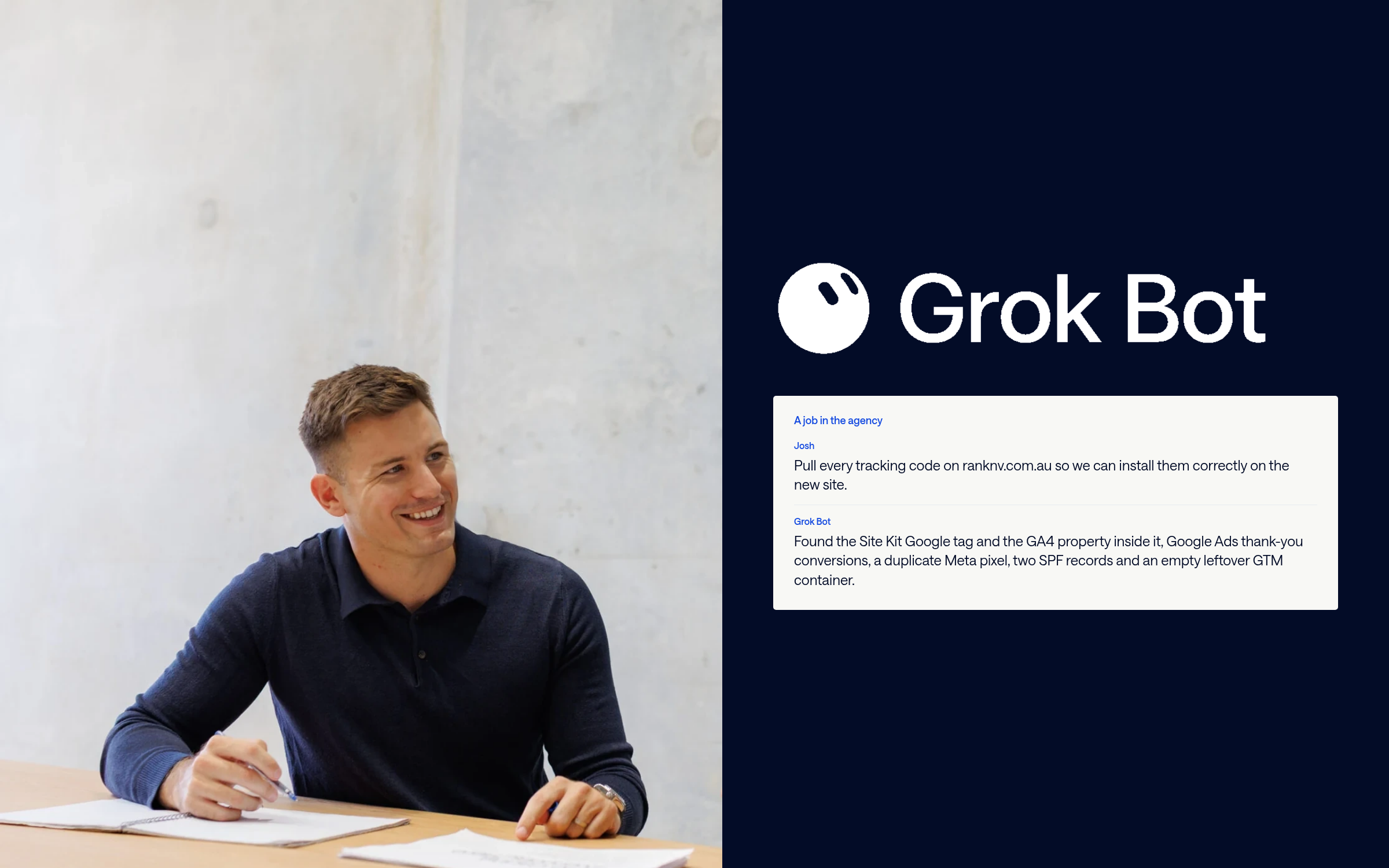
We used Grok Bot to pull every tracking code on our own website, ranknv.com.au, so the same tags can be installed correctly on the new site. It found the Site Kit Google tag and the GA4 property that already sits inside it, the Google Ads conversions that already fire on the thank-you page, the Meta pixel (and a duplicate we decided to drop), plus Yoast and DNS verification.
It also flagged problems that would have been easy to copy across by mistake: two SPF records on the domain, an empty leftover Google Tag Manager container that should not be reinstalled, and no Meta Lead event on the forms. That is the unglamorous work around SEO and Ads. If tracking is wrong, you cannot tell whether a page or a campaign is actually producing enquiries.
This is the same discipline we bring to a marketing audit or a site rebuild: look at what is really on the site, then decide what to keep.
2. A dedicated assistant for each client
We do not run the agency from one shared chat. Each client account has its own Grok Bot, already briefed on the website, the contacts, the files and the rules. Function bots sit alongside them, for things like conversion tracking, website security, visuals and incoming leads.
The point is memory and focus. The assistant can draft a page, a reply or a plan in that client’s context, without mixing one account into another. Nothing is sent, published or changed live until we sign it off.
3. Security and vulnerability checks
A site that is hacked, stuck on an old version of PHP, or running with an expired SSL certificate has a bigger SEO problem than a missing blog post. We have a security assistant that runs read-only checks: daily HTTPS and SSL reviews across the sites we host, and deeper reviews when a serious WordPress or PHP vulnerability is announced.
In October 2026, that included a review of a critical PHP vulnerability against our hosted sites, and a Patchstack rollout where it applied. The assistant recommends. We approve any change before it is made. That work sits with our website care and hosting, not as a separate AI product.
4. Page and section builds
Our builder assistants help plan and build WordPress pages, including custom sections, and can work from an existing site or animation as a reference. That is how we can quote a website in 3 to 4 weeks and still build something a client can actually use, rather than a generic template with new colours.
Copy, structure and design still get reviewed. Forms, redirects and tracking still get tested. Nothing is published until we sign it off. If you are considering a new site, that process lives on our website design work, not in an unattended AI builder.
5. Monthly reporting
Every month, clients should hear what we did, what moved, and what we are doing next, in plain English: rankings, calls, form enquiries, and the changes behind them. Our reports are due on the 15th.
Grok Bot can pull the data and draft that update. We still check it before it goes to the client. A useful report is not a stack of charts. It is an honest account of whether the work is producing enquiries, which is also how we run ongoing SEO and Google Ads.
6. Drafts, not sent messages
Grok Bot drafts client emails, launch checklists and internal notes. We send them. The draft is never the finished thing, and it never goes out in our name without a review. That sounds small. It is how you stop a fast tool from becoming a sloppy one.
What we will not use it for
We will not use Grok Bot to publish unreviewed blog posts at scale. We will not let it auto-publish to a client website, move a Google Ads budget, or change live tags on its own. We will not let it invent results, testimonials or rankings.
Those rules exist because of how search actually works, and because of how we want to be accountable. Google’s own spam policies already treat mass-produced, unreviewed pages as a problem. More importantly, a business owner is paying us to decide what is worth doing, and what is not.
Used carefully, Grok Bot is a serious productivity gain on the work around SEO: seeing what is actually on a site, preparing pages that answer a real question, checking technical and security issues, keeping tracking honest, and turning data into an update a business owner will read.
Used as a replacement for that judgement, it is just more noise in Google. It is also a poor way to get found in AI search. Thin, generic pages do not help you in ChatGPT or Google’s AI Overviews any more than they help you on page one.
So, is it good for SEO?
Yes, for the work that sits around SEO, when a human still owns the strategy and the publish button. No, if the plan is to let it write the website and hope Google sorts it out.
If you want to see how this looks on a real account, book a 30-minute call. Tell us what you sell, who you want more of, and what has or has not worked so far. We will tell you honestly what we would fix first, and what we would leave alone. Month to month, no lock-in.
Questions we get asked
Does using Grok Bot hurt your Google rankings?
Not if you use it to research, audit and draft, then publish only what you have reviewed. The risk is unreviewed, mass-produced content. We do not publish that, and we do not recommend it.
Can Grok Bot replace an SEO agency?
It can take on a lot of the gathering, drafting and checking. It cannot replace the decision about which services to target, whether a lead is any good, or what should not be published. That is still our job, and it is why you still deal with the people doing the work.
What SEO tasks is it actually good at?
The jobs in this post: inventories of tags and tracking, technical and security checks, first drafts of pages and reports, and keeping context on a client account. It is weaker when you ask it to invent a strategy or to write a generic article for its own sake.
Do you let it change a live website or Google Ads account?
No. It can prepare a plan or a draft change. We review it, then we make the change, or we approve it in writing first. Strategy, budgets and live sites stay under human control.
Is this the same as using ChatGPT for SEO?
The tasks overlap. The difference in our agency is the setup: a dedicated assistant per client, with the files and the rules already in place, and a hard sign-off before anything is sent or published. The tool matters less than how tightly it is briefed, and who is accountable for the work.